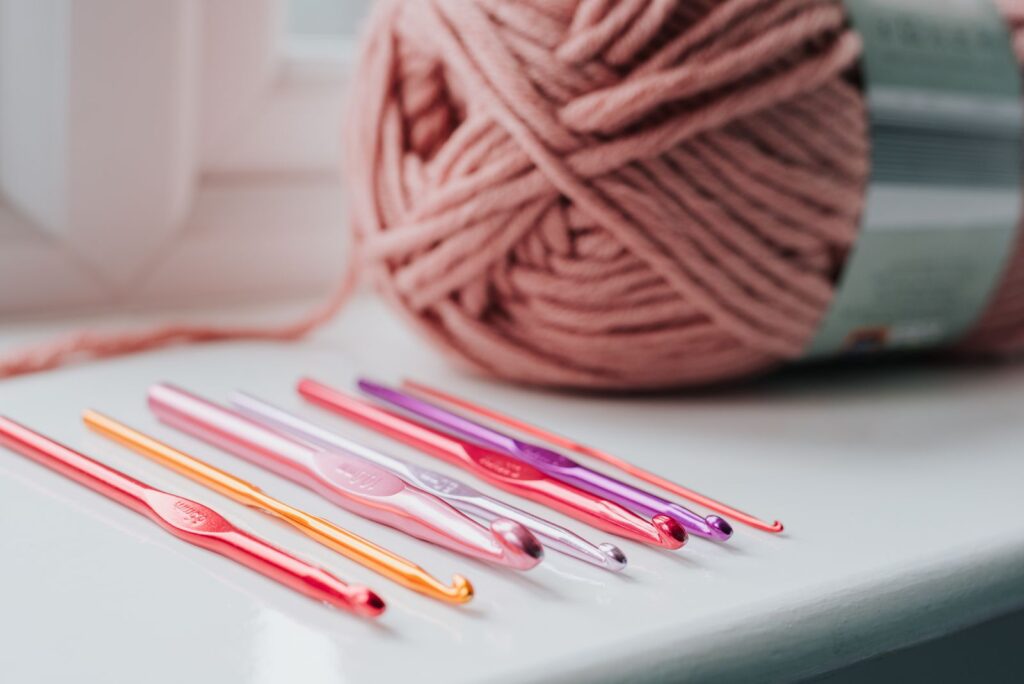
Walk into a craft store and you’ll find walls of crochet gadgets. The truth is, you can start crocheting with just a hook, a ball of yarn and a pair of scissors. Everything else either makes crochet a little easier or helps with specific projects. Here’s what’s worth buying first, what’s nice to have later, and what you can safely skip.
The essentials
1. Crochet hooks
Start with one or two hooks that match the yarn you want to use. For learning, a 5 mm (H/8) hook with worsted yarn is ideal. For amigurumi, you’ll want a 3.5 mm (E/4) hook. A basic set of aluminum hooks from 2 to 6 mm covers almost every beginner project. If you crochet for long sessions or have sore hands, an ergonomic hook with a soft, thick handle is the best upgrade you can make. Check our hook sizes chart to understand the different labels.
2. Yarn
Pick a smooth, light-colored, worsted weight (#4) yarn in cotton, acrylic or a blend. It shows your stitches clearly and is easy to undo if you make a mistake. Our guide to yarn weights explains the labels, and for toys see the best yarn for amigurumi.
3. Scissors
Any sharp scissors work. Small embroidery scissors are handy because they’re easy to carry and cut close to the work.
4. Yarn needle (tapestry needle)
A large, blunt needle with a big eye. You’ll use it to weave in ends, sew amigurumi parts together and embroider faces. Get a couple of sizes; a bent-tip needle makes sewing pieces together easier.
5. Stitch markers
Small clips that mark the first stitch of a round or an important spot in a row. They’re essential for amigurumi, where you work in a continuous spiral and can easily lose track of where each round starts. Locking markers (the ones that close like a safety pin) won’t fall out. In a pinch, a safety pin, paper clip or scrap of contrasting yarn works too.
Nice to have
- Measuring tape: for checking gauge and the size of hats and garments.
- Row counter: a small clicker or a phone app to keep track of rounds.
- Polyester fiberfill: essential once you start making amigurumi. See how to stuff amigurumi.
- Safety eyes: for toys. Our safety eyes guide shows which sizes to buy.
- Straight pins: to hold amigurumi parts in place while you check their position before sewing.
- A project bag: keeps your yarn clean and your hooks from getting lost.
- Embroidery floss: in black and pink for faces and cheeks.
Useful for specific projects
- Blocking mats and pins: for shaping granny squares, lace and garments.
- Yarn bowl: stops the ball rolling away while you work.
- Hemostat forceps: great for stuffing narrow amigurumi parts.
- Needle and hook gauge: measures hooks without labels and checks your gauge.
What you can skip at the start
- Huge hook sets with 20+ sizes: you’ll use three or four sizes most of the time.
- Expensive hand-dyed or luxury yarns: lovely, but frustrating to rip back while you’re still learning.
- Yarn winders and swifts: only needed if you buy yarn in skeins (loose loops) rather than balls.
- Specialty tools for one technique: buy them when a pattern actually needs them.
A simple beginner shopping list
- Hooks: 3.5 mm and 5 mm
- 2–3 balls of light-colored worsted cotton or acrylic yarn
- Small scissors
- 2 yarn needles
- A pack of locking stitch markers
- For amigurumi: a bag of fiberfill and a pack of 8 mm safety eyes
That’s everything you need to follow our beginner’s guide and make your first toy.
FAQ
Are expensive hooks worth it?
Not at first. A smooth aluminum hook works perfectly. Upgrade to an ergonomic hook if your hand gets tired.
What’s the difference between inline and tapered hooks?
Inline hooks have a head the same width as the shaft; tapered hooks have a rounder head that narrows into the throat. Neither is better; try both and keep the one that feels natural.
Do I need a different hook for each yarn?
You need a hook that fits the yarn weight, but one hook works with all yarns of that weight.
Cover photo: inspiration photo by Anete Lusina on Pexels