Crochet hooks are sold in three different sizing systems, and patterns don’t always use the one printed on your hook. A pattern might ask for a “G/6” hook while yours says “4 mm”, or an older British pattern might call for a “size 8”. This chart puts all three systems side by side so you can find the right hook in seconds.
The millimeter (mm) size is the most reliable, because it measures the actual diameter of the hook’s shaft. US letters and UK numbers are labels that can vary slightly between brands, so when in doubt, go by millimeters.
Crochet hook size conversion chart
| Metric (mm) | US size | Old UK size |
|---|---|---|
| 2.0 mm | – | 14 |
| 2.25 mm | B/1 | 13 |
| 2.5 mm | – | 12 |
| 2.75 mm | C/2 | – |
| 3.0 mm | – | 11 |
| 3.25 mm | D/3 | 10 |
| 3.5 mm | E/4 | 9 |
| 3.75 mm | F/5 | – |
| 4.0 mm | G/6 | 8 |
| 4.5 mm | 7 | 7 |
| 5.0 mm | H/8 | 6 |
| 5.5 mm | I/9 | 5 |
| 6.0 mm | J/10 | 4 |
| 6.5 mm | K/10.5 | 3 |
| 7.0 mm | – | 2 |
| 8.0 mm | L/11 | 0 |
| 9.0 mm | M/N-13 | 00 |
| 10.0 mm | N/P-15 | 000 |
| 15.0 mm | P/Q | – |
| 16.0 mm | Q | – |
| 19.0 mm | S | – |
A dash (–) means that size has no common equivalent in that system. Notice that the old UK numbers go down as the hook gets bigger, the opposite of the US system. Today most UK brands print the metric size, so you’ll mostly see these numbers in vintage patterns.
Steel hooks for thread crochet
Very small hooks used for lace and cotton thread are made of steel and have their own numbering, where a higher number means a smaller hook. Common steel sizes run from about 0.6 mm to 2.0 mm. If a pattern asks for a steel hook, check the millimeter size on the package rather than the number, because steel numbering also differs between brands.
Which hook goes with which yarn?
The yarn label usually recommends a hook size. Use this table as a starting point; for more detail see our full guide to yarn weights.
| Yarn weight | Typical hook for garments and blankets |
|---|---|
| #1 Super fine (fingering, sock) | 2.25–3.5 mm (B/1–E/4) |
| #2 Fine (sport) | 3.5–4.5 mm (E/4–7) |
| #3 Light (DK) | 4.5–5.5 mm (7–I/9) |
| #4 Medium (worsted, aran) | 5.5–6.5 mm (I/9–K/10.5) |
| #5 Bulky (chunky) | 6.5–9 mm (K/10.5–M/N-13) |
| #6 Super bulky | 9–15 mm (M/N-13–P/Q) |
| #7 Jumbo | 15 mm and larger |
Why amigurumi uses a smaller hook
For stuffed toys you want a tight, dense fabric so the stuffing doesn’t show through the gaps. That’s why amigurumi patterns go 1 to 2 sizes smaller than the yarn label suggests. For example, our patterns like the chibi snowman use worsted yarn with a 3.5 mm hook, even though the label recommends 5 mm or more.
How to check your hook size
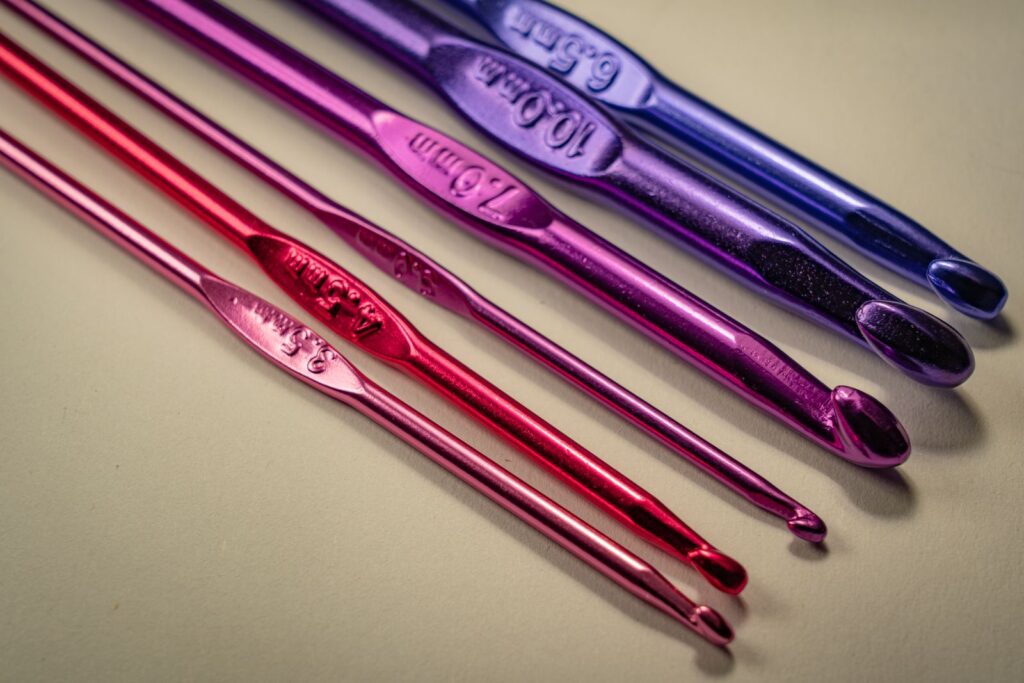
If the label on your hook has worn off, use a needle and hook gauge: a small card or ruler with holes of different sizes. Slide the hook’s shaft (not the tip or the handle) through the holes until it fits snugly. Many gauges also measure your stitch tension.
When to change hook size
- Your project comes out bigger than the pattern: go down half or one hook size.
- Your project comes out smaller or feels stiff: go up half or one hook size.
- Your gauge swatch doesn’t match: change the hook, not the way you crochet. It’s much easier to swap hooks than to change your natural tension.
FAQ
What size crochet hook is best for beginners?
A 5 mm (H/8) hook with worsted weight yarn is the easiest combination for learning, because the stitches are big and easy to see.
Is a 4 mm hook the same as a G hook?
In the US, G/6 is 4 mm. Some older brands labeled a 4.25 mm hook as G, so always check the millimeter size.
Do hook materials matter?
Aluminum hooks are smooth and fast, bamboo and wood grip the yarn a little more, and ergonomic handles reduce hand strain. The size is what affects your results; the material is personal preference.
Pin this chart or bookmark this page so you always have it nearby when a pattern uses a sizing system you don’t know. For the full list of tools worth buying, see crochet tools every beginner needs.
Cover photo: inspiration photo by Castorly Stock on Pexels